|
 |
The most efficient and enjoyable way to experience Havana
is via your own two feet.
You'll find monuments, restaurants,
museums, forts, and hotels all within easy walking distance of one
another. And while you're walking, you'll get to experience the
highly social street life of Old Havana.
It's the streets and parks that supply the energetic rhythm for the
city. Sidewalks line every
street, many of which are too narrow for cars to navigate.
Smiling, or saying Hola! are all appropriate
casual exchanges when passing by. Greetings of Beunos dias,
good morning or Beunos tardes, good afternoon are always
appreciated.
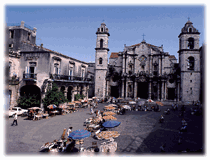
Plaza de la Catedral
The best place for visit in Old Havana
From the beginning of the flea market in Old Havana stalls
on Tacon, turn right to intersect with
Empedrado. In a matter of feet Empedrado street
opens onto the pleasant courtyard of Plaza
de la Catedral.
Around the Plaza
Completed in 1787, the Catedral de Habana
forms the eastern wall of the Plaza de la
Catedral. The cathedral is open infrequently
but you can always appreciate its baroque
exterior.
Before the revolution the cathedral
garnered attention for housing Christopher
Columbus' bones.
After the revolution in
1959, these prestigious remains moved to
Santo Domingo, but it was later discovered
that they were not Coumbus' remains after
all.
Opportunities to participate in the daily
rhythms of Havana abound at Plaza de la
Catedral.
Salsa players performing for the
crowd at Le Patio, an upscale restaurant
and bar, wink and smile to encourage you
to get up and dance. Perhaps you'll
encounter the cathedral's bell ringer, who'll
extend an invitation to join him in the tower
the following morning.
There is a small gallery beside Le Patio
that exhibits and sells professional Cuban artists' paintings,
ironworks, ceramics and woodworks. Anytime is a good time to
visit this area.>
Covered stone archways to the right of the cathedral
contain renovations-in-progress and a small tourist office
where you can purchase a phone card, make calls and
faxes, or buy additional maps.
Opposite the cathedral is the
square's oldest structure, built in 1720. Originally a private home,
it now houses the Museo de Arte Colonial , Museum of Colonial
Art.
Even if period fixtures don't interest you, the view across
the square from the museum's balconies is worth the price of
admission.
Taller Experimental de Grafica, Experimental Workshop of Graphic
Arts is located at the end of Callejón del Chorro, a short alley
jutting from the southwest corner of the Plaza.
Here you'll find
prints of higher quality and price, than those offered by street
vendors.
|
|
|